
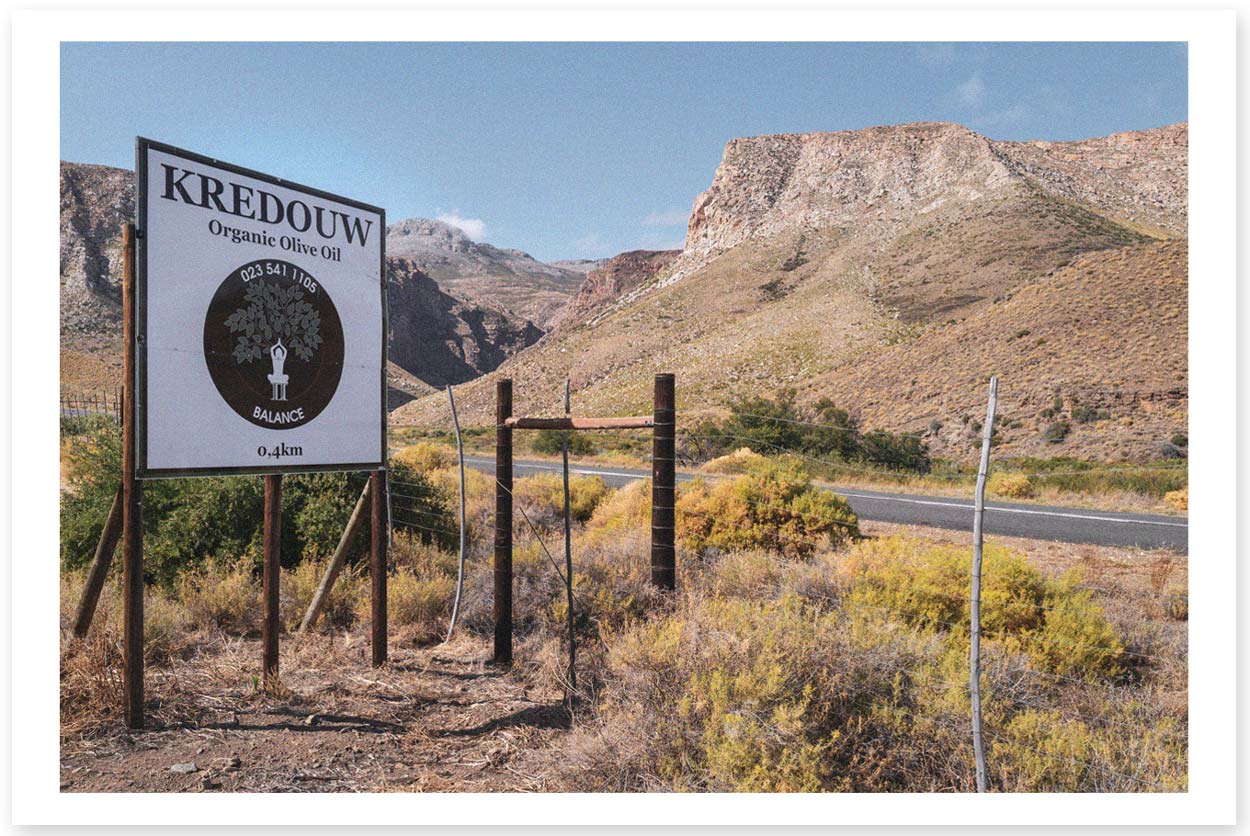
I feel strangely emotional.
We were there just 20 minutes ago but it was such a profoundly moving place I feel a pang in my stomach when we leave.
As soon as we set foot on Kredouw Olive Estate a part of us dropped anchor.
This is it, we thought. Pure Karoo magic.
Silvery green olive tree leaves feather the foreground. There are quirky, beautiful buildings dotted all over the place. All flanked by stunning landscapes.
I find myself rubbernecking. To the left melted red and orange layers of the nearby mountains. Straight ahead a perfect view of the Prince Albert Valley.
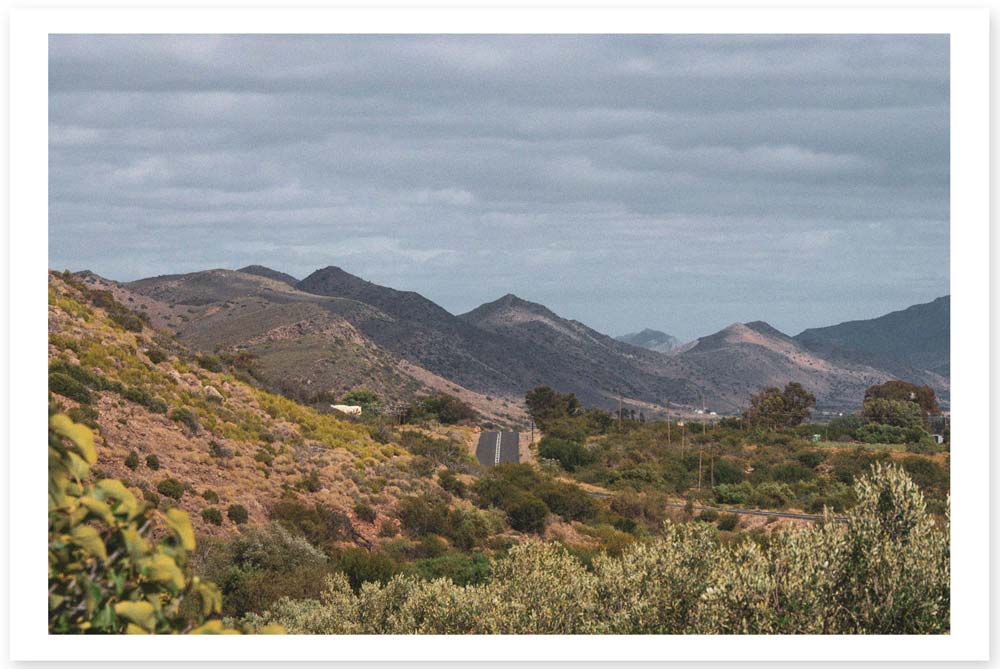
For over 2 months now we’ve been living in the town of Prince Albert.
And for 2 months we’ve driven over this pass and thought, wow, THIS is the view.
But until now we had only ever seen it from the car. I’ve tried taking pictures at absurdly high shutter speeds to capture its beauty but it’s always missing something.
You can’t drink in the surroundings in quite the same way when you are hurtling down a highway.
Kredouw sits right at the base Prince Albert Valley.
It’s nestled between mountains. The road is hidden once you’re inside. It even seems to have its own microclimate.
A cool wind greets us as we walk to the little shop.
Louisa and her husband have been the custodians of Kredouw olive farm for over 12 years.
They’re about to embark on a new chapter but for now (at the time of writing) they are still here, luckily for us.
Their passion and hard work and vision has given this place real soul. It’s in the artwork, the furniture, the books she’s published.
We start with an olive tasting and get to try the different varieties they produce on the farm, sipping them from little bowls.
My favourite is the Italian. The peppery finish gives it a kick and means it contains plenty of those all important health giving polyphenols (don’t ask me why I know). Kat likes the blend which has a subtle mix of butteriness and fire.
After that we sit and have a pot of coffee outside and drink in the views. There cannot be many places in the world like this.
The History of Kredouw Olive Farm
So what is this place and how did the olive farm come about?
Kredouw is nestled in the dramatic Kredouw Pass, as I mentioned previously between Prince Albert and the vast, open plains of the Karoo.
The farm itself has a history stretching back over a century. It originally served as a stopover for weary travellers making their way through the rugged pass.
The name Kredouw gives us a hint at its past.
It comes from the Khoisan word meaning “narrow passage,” a reference to the winding path through the mountains. Louisa believes there is also a connection in the meaning to the feminine here.
Natural features like mountain passes can have symbolic associations with feminine qualities, representing gateways, transitions, or sources of life.
Over time, the land here changed hands. While much of the surrounding area remained dedicated to traditional Karoo sheep farming, in the early 2000’s Kredouw was transformed into an olive estate.
Olives thrive on adversity and poor soil. Minimal water and extreme temperatures intensify their flavour.
Kredouw’s groves benefit from the farm’s unique microclimate, where cooler mountain breezes temper the heat. A steady underground water supply from the Swartberg ensures just enough hydration for the trees to flourish.
Today, Kredouw produces a variety of extra virgin olive oils, each with its own personality. Some are bold and peppery, perfect for drizzling over Karoo lamb, while others are mellow and buttery, ideal for dipping with fresh bread.
Their olives are hand-harvested and cured using traditional methods and, at the time of writing, we were told are one of the only truly organic olive farms in the region.
Beyond the olives, Kredouw Olive Estate has become a gathering place for artists and those seeking the quiet magic of the Karoo.
Louisa kindly lets us look around.
There is an art gallery in the gardens showcasing walls of beautiful modern art and a delicate walkway through some of the olive groves.
There’s also a maze. When I get a chance I must ask someone about the South African obsession with mazes.
Almost everywhere we have visited on the Western Cape has a tiny maze.
There’s a little maze on the Koppie in Prince Albert, there were little mazes in Franschoek. There were mazes all along the Garden Route. There’s yet another one here.
Specifically I want to know if they are used as mazes. In the UK the few mazes I’ve come across, usually visiting National Trust properties, are carved by giant 10 foot, toperieried hedges. Impossible to see through or over. The purpose is to confuse, delight and give you a sense of smallness and place.
You can easily spend anywhere between an hour and a 20 years getting lost.
Here the mazes are typically circular, only a few metres wide and marked by stones or boulders. Also, and this is the part that I’m interested in, you can see all the paths and the deadends from a birdseye view at all times, in advance. It’s like playing poker and seeing your opponents hands.
My sincere hope is that these mazes specifically made exclusively for the enjoyment of tortoises, dassies and other low to the ground creatures.
I did not expect to be writing a post on Kredouw Olive Estate.
We’ve been to a few olive estates during our time here and they are typically beautiful, peaceful places. They usually do nice coffee and have pleasant gift shops which is great but perhaps not a dedicated article.
Reading this article back it feels almost like I’ve fallen into a strange delusion. But that is how I feel about many of these places.
In the Karoo you come across these startlingly beautiful oases that have been setup, or are run by, the most extraodrinary people.
People with a white hot passion for what they are doing and with a real pride and open-heartedness.
Every time we settle into life in the Karoo we think we have had our fill of wonder and every time the Karoo surpises us.
I know if we came back in a different season the experience would be new again.

0 Comments